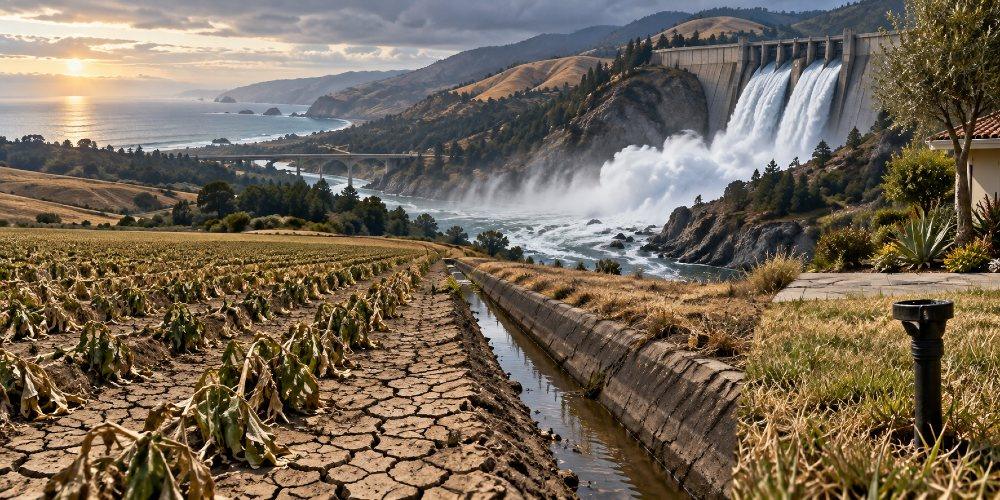
Mark Twain is supposed to have said whiskey is for drinking and water is for fighting. California’s ruling class has a third option. Let the water run into the Pacific, then lecture the rest of the state about shorter showers.
Joel Kotkin laid it out Friday in the New York Post, and the picture is not complicated. Sacramento will not store water when God sends it. Then Sacramento will police lawns, gardens, and bathrooms when the dry months come. That is not climate science. That is ideology with a clipboard.
For my people have committed two evils; they have forsaken me the fountain of living waters, and hewed them out cisterns, broken cisterns, that can hold no water.
The Ban Comes First. The Reservoir Comes Never
The state has already tightened watering rules on commercial properties. More limits on gardens and showers are expected. AB 1572 phases in a ban on using drinking water to irrigate “nonfunctional” decorative grass on government, commercial, and HOA common areas. Functional turf for kids and sports gets a pass. The strip of lawn along a parking lot does not. Recycled water is fine. Potable water is the enemy.
Fine. Waste is waste. The insult is what Sacramento refuses to do on the other side of the ledger.
In 2014, voters passed Proposition 1 and told the state to build storage. Twelve years later, three of the four major reservoir proposals are dead. They died the usual California death. Years of CEQA review. Activist lawsuits. A regulator who discovers, late in the process, that the fish need the water more than the farms.
The last project still breathing is Sites Reservoir, a planned 1.5-million-acre-foot off-stream lake in Glenn and Colusa counties. It would pull high Sacramento River flows in wet years and hold them for dry ones. No dam across a wild river. Flood capture. Drought insurance. The kind of thing a serious state would have finished a decade ago.
Instead, as Kotkin notes, a state agency earlier this year decided Sites could not use more than about 34 percent of its long-planned supplies in order to “save” the Sacramento-San Joaquin Delta and its marine inhabitants. Project director Jerry Brown has warned that stacked conditions on river diversions and pending Bay-Delta flow rules could cut the reservoir’s yield by as much as half. A half-empty promise at full price is not a reservoir. It is a monument to process.
Gavin Newsom still poses with the check. In June his office bragged about another $269 million and a total of $1.36 billion in state eligibility. Construction is still a maybe. The State Water Resources Control Board is looking at a November vote on the water right. Environmental groups already sued after a six-year public review. The streamlining law that was supposed to kill frivolous delay did what California streamlining always does. It streamlined the lawsuit.
They Will Not Fill the Barns in the Fat Years
Joseph told Pharaoh to store grain in the seven fat years so Egypt would not perish in the seven lean. California does the opposite. In the wet winter of 2017, Oroville spilled and a river of unused water ran out through San Francisco Bay. The same pattern repeats whenever the storms come. Most of the Sacramento River still goes to sea.
The excuse is the Delta smelt. No native smelt has been detected since 2018. The recovery plan failed. Scientists admit they still do not adequately understand the system. The Delta has been a working, dredged, diked, pumped landscape since the Gold Rush. Treating it as a cathedral that must be restored to some imagined 1848 purity is not conservation. It is a religion that happens to require other people’s showers.
Greens say climate change will make California ever more arid, which is their argument for doing nothing that would actually hold water. If the future is drier, you build more storage, not less. You build desalination. You recharge groundwater when the floods come. You do not flush the surplus and then fallow the San Joaquin Valley.
Planned supply cuts could take as many as 900,000 acres of farmland out of production. That is not a lifestyle choice. That is food. California still feeds a large share of the country. When those acres go brown, the shortage does not stay in Sacramento. It shows up in the grocery aisle.
Colorado River allocations are tightening at the same time. Rep. Harriet Hageman has already warned that blue-state water failures threaten food supplies well beyond California’s borders. Lake Powell has been scraping historic lows. California takes the largest Lower Basin share and still will not finish the storage voters funded on its own rivers.
The Washington Examiner put the dependence problem plainly. The state leans on water from outside its borders because it will not harness the water inside them. Record rain years come. The runoff still goes to the ocean. Activists keep the pumps throttled for fish that are already gone.
Desalination Was Available. Activists Killed It
Ed Ring of the California Policy Center told Kotkin the quiet part. Desalination could help, but you run into the bureaucracy and the environmental community. “We face shortages, but they really don’t want to do anything about it.”
Huntington Beach proved the point. Poseidon’s plant would have made tens of millions of gallons a day on an industrial site in Orange County. Newsom even backed it. The Coastal Commission killed it unanimously in 2022. Marine organisms. Ratepayer cost. The wrong project in the wrong place at the wrong time, they said, during a drought. San Diego already runs a similar plant. Orange County was told to stay thirsty.
This is the same state that built the Los Angeles Aqueduct, Hetch Hetchy, and the State Water Project. Those works made modern California possible. The men who built them understood that a desert civilization stores water or it dies. The people running Sacramento now treat that inheritance as original sin.
Californians asked the obvious question during the last flood winter. Where are the reservoirs the voters already paid for? They are in binders. They are in court. They are in a draft permit that lets the lake exist on paper so long as it cannot actually fill.
Kotkin’s forecast is the honest one. Fewer farms. Brown neighborhoods. Dead gardens. Shorter showers. Sacramento expects farms and families to take the cut like peasants while the unelected water board and the well-funded green machine decide how much of a wet year is allowed to be saved.
A state that will not store water in the rain has no moral standing to lecture anyone about the faucet. Build the reservoirs. Permit the plants. Stop sacrificing the Central Valley on an altar to a fish that is no longer there. Or keep flushing the gift down the Golden Gate and call the rationing compassion.