
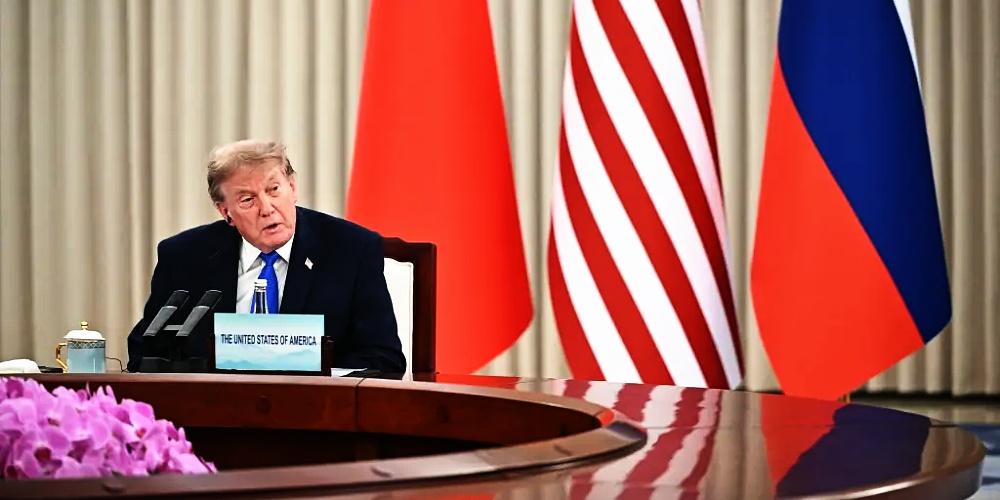
President Trump just spent eighty minutes in a room in Shenzhen with Xi Jinping and Vladimir Putin and told them the quiet part out loud. The old way of American diplomacy never solved anything because it refused to talk about the hard problems. Then he floated the idea that the three biggest nuclear powers on earth each only need about ten bombs.
That is not the language of Foggy Bottom. It is the language of a man who has already watched New START expire and watched China race to catch up while the State Department issued press releases. The New York Post reported the first-ever trilateral summit between the leaders of the United States, Russia, and China.
It started two hours late, included ten minutes of cameras, and produced a four-point joint declaration from Beijing and Moscow that the White House has not yet fully owned. The declaration calls for more dialogue on nuclear risks, unspecified United Nations reforms, more oil production, and condemnation of the International Criminal Court that has indicted Putin.
Trump’s own words in the room were sharper. “No problems were ever solved under the old school refusing to talk about them,” he said. “No peace was ever forged by declining opportunities for engagement and speech.” He framed the meeting as a chance for the three largest nuclear powers “to discuss how to reduce the number of nuclear weapons on Earth, and also to lessen the risk that those weapons will ever be used.” Later, on Fox News, he got specific.
The United States has about 4,000. Russia has about 3,800. China has 400 or 500 and is “going hot and heavy.” Then the line that will either age well or become a cautionary tale: you only need about ten.
As the world’s three largest nuclear powers by far, the United States, Russia, and China are uniquely positioned to discuss how to reduce the number of nuclear weapons on Earth.
Xi agreed in principle that nuclear weapons “should be comprehensively banned and thoroughly destroyed.” Putin called the three men guardians of world peace and said their peoples can strengthen security if they “cooperate constructively.”
Both of those statements are easy to make when your country is still building. China’s stockpile is smaller on paper, which is exactly why Beijing has spent years refusing to join the kind of verifiable cuts Washington and Moscow have already done. An administration official called the nuclear conversation a preliminary step, not a deal. That is the honest reading.
Scripture is clear that the desire for peace is not the same as the achievement of it. “If it be possible, as much as lieth in you, live peaceably with all men.”
That verse from Romans does not require pretending an adversary has stopped expanding its arsenal or stopped exporting the fentanyl that has killed roughly half a million Americans during Xi’s time in power. Trump and Xi also discussed trade and that fentanyl flow. Separate meetings happened earlier. Trump offered his hand. Xi took the forearm on the escalator after a tarmac hug. Putin got a joke about “Who is he?” followed by “He’s my friend.” Optics matter less than whether the warheads actually come down.
The rest of the agenda was equally large and equally unfinished. Trump raised ending the wars in Iran and Ukraine and working against “rogue globalist organizations” such as the ICC in the name of national sovereignty. China and Russia’s declaration hits the ICC and calls for more oil. Those are not the same as a ceasefire or a verifiable nuclear reduction.
Meanwhile Chinese officials barred a Bloomberg reporter from the trilateral after she shouted a question at Trump about the ousted Nvidia CEO and an alleged Chinese spy. The White House tried to reverse it. Beijing called her conduct “extremely rude.” That is the same country talking about open dialogue on nuclear weapons.
None of this means the meeting was worthless. The old school Trump dismissed really did treat engagement with adversaries as a moral concession rather than a tool. Talking is not surrendering. But neither is a photo opportunity a treaty.
The power of these weapons is, as Trump put it, “unbelievable, unthinkable.” That is why the United States has maintained a large arsenal for decades and why any serious reduction requires inspections, verification, and a Chinese stockpile that stops growing first. Until those pieces exist, “about ten” remains a provocative goal, not a plan.
The three leaders left Shenzhen with a joint statement drafted by two of them and a president who has spent years arguing that strength and directness beat process for its own sake. History will judge whether the bombs actually get smaller or whether the conversation simply continues while the numbers go the other direction.
For now the record shows Trump said the quiet part, put the largest nuclear powers in the same room, and refused to pretend the old diplomatic habits had worked. That is more than most summits deliver. It is still not a finished deal.