
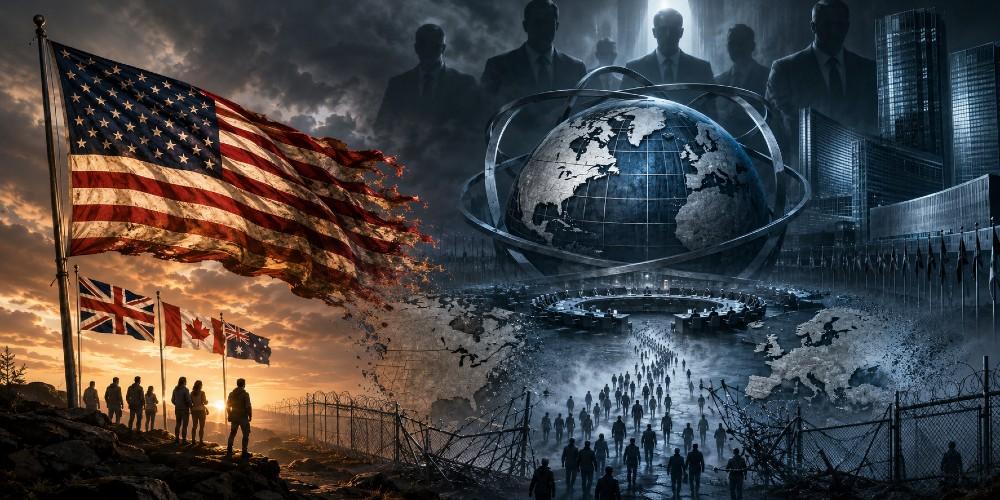
Some politically charged words become part of our common vocabulary almost overnight. “Globalism” is a timely example. Ten or fifteen years ago, calling someone a “globalist” didn’t have much effect. Today, it is well understood as a pejorative that highlights someone’s allegiance to international institutions over those created within a nation state.
Although the term has been used in various academic circles for more than a century, it didn’t become part of our common political parlance until anti-Establishment conservatives in the United States and Europe found it a useful taxonomic description of their ideological opponents. In hindsight, it is surprising how long the word “globalism” remained dormant and hidden away in the context of political speech and debate.
During the Cold War, however, the world was divided between the Soviet Union and the United States, between communism and freedom, between closed economies and open markets. To the extent that nationalism and globalism were distinguished from each other, academics and political leaders did so under the umbrella of the Cold War contest between East and West to gobble up as many nation states as possible. Both sides embraced a “domino theory” of geopolitics in which partisans fought for global domination, one nation at a time.
There was, however, an intentional, albeit rarely described, linguistic shift from the 1950s forward. In newspapers and scholarly essays of the nineteenth and early-twentieth centuries, “nationalism” and “patriotism” were largely used interchangeably. Following WWII, “nationalism” increasingly acquired a negative connotation until eventually becoming a proxy word for “fascism” or “Nazism.” In our current age, prominent political and academic leaders speak of “nationalism” as if it were a virulent form of racism, imperialism, and authoritarianism rolled into one malevolent philosophy.
In contrast, until rather recently, “patriotism” retained a positive meaning, even though its Greek roots describe a person’s connection to “fellow countrymen” and the “fatherland.” If only one of these two words — “nationalism” or “patriotism” — were to survive WWII unchanged, a reasonable person might have wagered that “nationalism” seemed more innocuous and less “problematic” for contemporary sensibilities and therefore more likely to endure with its politically neutral meaning intact. “Patriotism,” on the other hand, with its emotional appeal to the “fatherland,” might have appeared more objectionable.
Instead, “nationalism” was eventually demonized for its semantic connection to the “national socialism” of the Nazi Party, while “patriotism” was embraced as an essential quality for Western citizens fighting the Soviet Union’s communist expansion during the Cold War. This was not a historical accident.
After WWII, there was a concerted effort among political and intellectual leaders in the West to use the destruction from two catastrophic global wars as a profound moral argument for charting a new course for humanity. Framing the carnage of those wars as the natural result of unbridled “nationalism,” architects of the post-war world put their faith in international institutions.
The United Nations, the North Atlantic Treaty Organization, and the European Union all emerged immediately after WWII but so did a thousand new international bodies constructed to do everything from standardizing industrial production in factories around the world to regulating the movement of people and goods across borders. “Internationalism” was sold as an antidote to war and therefore became almost synonymous with “peace.”
The dichotomy between “nationalism” and “internationalism” was much easier to advance publicly than a contrast between patriotic love of country and an unpatriotic hatred for one’s countrymen. The United Nations decided that patriots could be internationalists. Nobody asked out loud whether internationalists could be patriots.
This paradigm has remained attractive for its simplicity but never made much sense.
For starters, German Nazism, Italian fascism, and Japanese imperialism (in which an absolute monarch was worshipped as a deity) were not inherently dangerous because their proponents organized power through national governments. They were dangerous because they were totalitarian in nature and compelled citizens to sacrifice themselves completely in the interest of the State. Had the Germans, Italians, and Japanese strongly believed in limiting government power and maximizing personal freedom, respect for individual rights would have kept expansive authoritarianism in check.
It is illogical to assume that international forms of government are somehow more humanitarian or philanthropic than national forms, just as it is illogical to assume that national forms of government are more just and capable of representing citizens than local municipal governments. One might ask what the difference is between the Green Party in Germany demanding total civilian obedience to “global warming” mandates and a group of international ambassadors demanding the same thing through the Paris Climate Accords.
Are the United Nations Framework Convention on Climate Change and the Intergovernmental Panel on Climate Change somehow less totalitarian because international bureaucrats are regulating the behavior of both Germans and non-Germans alike?
Would we not describe the great empires of the past as “globalist” or “international” in nature? Did Alexander the Great, Julius Caesar, Napoleon Bonaparte, or Cecil Rhodes not swallow up entire nations when they expanded the territorial dominions of their respective empires? How does one distinguish those global empires from modern equivalents such as the European Union or the United Nations?
Surely the average European, Asian, or African finds it just as difficult to object to an edict coming from the E.U. or U.N. as it would have been for Europeans, Asians, or Africans of the past to resist imperial edicts from faraway capitals. Had Alexander, Caesar, Napoleon, or Queen Victoria described their empires as “united nations,” would their conquests have been considered more just and peaceful?
In other words, have we not simply rebranded imperialism as “internationalism” and pretended that the rhetorical distinction represents “progress”?
This brings us to the current day, when we are finally having a meaningful debate regarding the merits of “nationalism” versus “globalism.” As has become all too evident in recent years, globalists really do wish to dispense with the nation state. But they are not content with merely replacing national governments with international institutions.
Decades of open borders policies in North America and Europe reveal globalism’s true goal: to eradicate the vestiges of culture and history that bind a nation’s people together. In the United States, it is quite common to see immigrants flying their “home” flags in sports stadiums, while mainstream news pundits describe the American flag as a form of “white supremacy.”
Across the United Kingdom, government officials are cracking down on citizens who wave British flags. On both sides of the Atlantic, globalists berate citizens for not embracing “multiculturalism.” We have finally reached a point when “patriotism” is demonized just as much as “nationalism.”
Without nations or patriots, where does that leave us? It leaves us with continental landmasses filled with strangers. Instead of people bound by common history, culture, religion, values, language, and family, North America and Europe are being transformed into spaces defined by absolutely nothing.
America’s new immigrants want to do away with the political ideals of the Declaration of Independence and the U.S. Constitution. Europe’s new immigrants insist on replacing all the Christian churches with mosques.
Both continents are heading for a future when tribes of distinct peoples will fight for political power within turbulent territories that remain nations in name only. Does anyone really believe that they will put aside their disagreements and obey the international proclamations of the United Nations or the European Union?
Eighty years of “internationalism” have destroyed the most natural political order that has ever existed: the nation state. Now entire continents are filled with immigrants whose incompatible cultures ensure future conflict. And instead of recognizing how destructive their policies have been across the West, globalists have the audacity to ridicule nationalists as threats to peace.
The most important lesson from WWII was not that nations are bad but that totalitarian government is evil. Globalists sacrificed the former and embraced the latter. Westerners will now have to defeat globalism, too.