(The Epoch Times)—U.S. President Donald Trump’s ultimatum for Iran to agree to a peace deal is set to expire on April 6, and with talks appearing to show no meaningful progress, the risk of a sharp escalation in the war looms large.
Senior Israeli officials told Epoch Magazine Israel on April 3 that talks between Washington and Tehran—being conducted indirectly through Pakistan’s army chief—have so far faltered and have not produced any meaningful breakthrough.
According to those sources, if no agreement is reached before the deadline, Trump may order a significant escalation in the fighting.
Trump has in recent days intensified his warnings to Iran, threatening to expand strikes on Tehran’s critical infrastructure, including bridges and electric power facilities.
“Our Military … hasn’t even started destroying what’s left in Iran. Bridges next, then Electric Power Plants!” Trump wrote in an April 3 post on Truth Social.
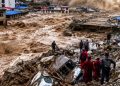
The warning followed a U.S. strike on a major bridge near Tehran, identified by a U.S. official as the B1 Bridge connecting the capital to Karaj.
The official said the objective was to disrupt a key military supply route used to sustain Iran’s ballistic missile and drone capabilities.
Trump shared footage of the strike online, writing that more attacks could follow unless Iran agrees to a deal.
“The biggest bridge in Iran comes tumbling down, never to be used again—Much more to follow!” Trump wrote in a post on Truth Social.
“It is time for Iran to make a deal before it is too late, and there is nothing left of what still could become a great country!” he added in all-caps.
The escalation in targeting signals a potential shift in the campaign toward degrading Iran’s infrastructure more broadly, a move that could deepen the humanitarian and economic toll of the war.
Israeli Prime Minister Benjamin Netanyahu said on April 3 that Israel’s operations are being carried out in close coordination with Washington and have already significantly degraded Iran’s industrial base.
“In full coordination between President Trump and me, we will continue to pound Iran. This regime is weaker than ever,” Netanyahu said.
He added that Israeli airstrikes have destroyed roughly 70 percent of Iran’s steel production capacity in recent days, calling it a “tremendous achievement” that limits the Islamic Revolutionary Guard Corps’ access to funding and its ability to manufacture weapons.
Iranian Foreign Minister Abbas Araghchi condemned the strike as an attack on civilian infrastructure, saying it would be ineffective at forcing Tehran’s surrender and would instead tarnish Washington’s image.
“Every bridge and building will be built back stronger,” Araghchi wrote in an April 2 post on X. “What will never recover: damage to America’s standing.”
Iranian state media reported that at least two civilians were killed in the bridge strike, with several others injured. Separate reports said strikes had also hit health care infrastructure in Tehran and beyond.
World Health Organization chief Tedros Ghebreyesus said in a post on X that recent attacks have damaged medical facilities in Tehran and elsewhere in the country, including the Pasteur Institute, a medical research center, with more than 20 verified attacks on health care infrastructure since March 1, leaving at least nine dead.
“The Delaram Sina Psychiatric Hospital sustained significant damage due to a strike on 29 March, and the Tofigh Daru pharmaceutical facility, which produced medicines for treating cancer and multiple sclerosis, was damaged in another attack on 31 March,” he added.
“The conflict in Iran, and the region, is impacting the delivery of health services and the safety of health workers, patients, and civilians present at health facilities. Peace is the best medicine.”
Diplomacy Through Pakistan Faces Uncertainty
Even as military pressure mounts, Washington has continued to signal that diplomacy remains possible.
Trump has said that peace talks have been ongoing—both direct and indirect—while Iranian officials have dismissed that characterization, saying that only preliminary exchanges of messages are taking place and that this does not amount to actual negotiations.
Pakistan said on April 2 that it is prepared to host talks between the United States and Iran, positioning itself as a key intermediary in efforts to de-escalate the conflict.
A spokesperson for Pakistan’s Foreign Ministry said both sides had expressed confidence in Islamabad’s role, though no timeline has been set and any negotiations would depend on when Washington and Tehran are ready to engage.
U.S. special envoy Steve Witkoff has confirmed that a 15-point framework for a potential cease-fire has been conveyed to Iran through Pakistani mediation, describing the exchanges as constructive.
Witkoff said during a recent Cabinet meeting that Iran is “looking for an off-ramp” following Trump’s threats to escalate strikes against Iranian energy infrastructure.
Iranian officials have publicly rejected the notion that formal negotiations are underway.
Araghchi said in a recent interview that Tehran is receiving messages—some direct and others via intermediaries—but does not consider this a negotiation process. He added that Iran has not formally responded to the U.S. proposal and continues to demand a full end to hostilities, guarantees against future attacks, and compensation for damages.
Israeli officials told Epoch Magazine Israel that Washington has privately urged restraint in certain areas. According to those sources, the United States has asked Israel to refrain from targeting key Iranian figures, including Supreme Leader Mojtaba Khamenei, parliamentary speaker Mohammad Bagher Ghalibaf, and Araghchi, in order to preserve the possibility of a diplomatic breakthrough.
The requests suggest that while Washington is escalating military pressure, it is also seeking to avoid actions that could derail backchannel contacts or foreclose a negotiated settlement.