
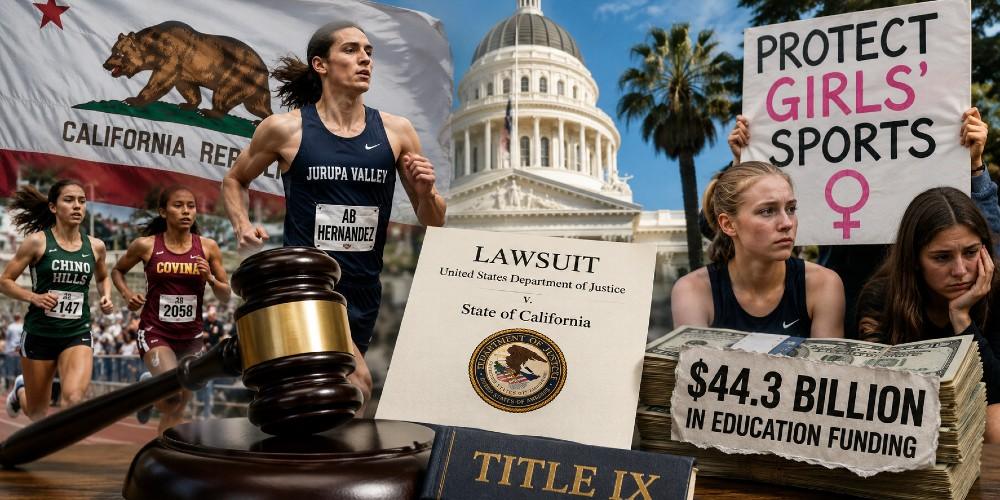
A federal judge has thrown out the Trump administration’s Title IX lawsuit against California — not because she found the state’s policy fair, but because she found the paperwork insufficient. That distinction matters, and it’s the entire story.
U.S. District Judge Cynthia Valenzuela, a Biden appointee sitting in the Central District of California, dismissed the Department of Justice’s case with prejudice this week, ruling that the federal government never gave California clear enough notice that its transgender athlete policy could cost the state $44.3 billion in education funding.
Under Spending Clause doctrine, Washington cannot retroactively punish a state for violating a condition it never explicitly spelled out. That legal technicality, not the underlying question of fairness in girls’ sports, is what killed the suit.
A Lawsuit Built on Fair Play, Dismissed on a Technicality
The DOJ filed suit in July 2025, arguing that the California Department of Education and the California Interscholastic Federation violated Title IX by letting biological males who identify as female compete on girls’ teams.
The case was led by Harmeet Dhillon, now heading DOJ’s Civil Rights Division, and Bill Essayli, the U.S. Attorney for the Central District of California. Both had spent years as outside critics of Sacramento’s gender policies before landing in positions to fight them directly.
Valenzuela didn’t dispute that Title IX permits schools to maintain sex-separated teams. She simply concluded the law doesn’t require every state to exclude transgender athletes from girls’ competition — and that California was never clearly warned otherwise before the DOJ came after its funding.
A DOJ spokesperson said the department is evaluating an appeal, adding that officials are “disappointed by the Court’s order” while remaining committed to keeping biological males out of girls’ sports.
The Supreme Court Left the Door Open, Not Closed
Valenzuela’s ruling leaned on the Supreme Court’s June 30 decisions in West Virginia v. B.P.J. and Little v. Hecox, which upheld state laws restricting trans athletes to categories matching their biological sex.
But the justices stopped short of mandating that standard nationwide, and they explicitly declined to resolve whether Title IX itself permits transgender participation in girls’ sports. Valenzuela treated that silence as license for California to keep its policy — a reading that leaves the actual fairness question untouched by either court.
The Human Cost Behind the Legal Theory
Sacramento has allowed transgender-identifying male athletes to compete in girls’ sports since 2013 under a policy backed by Gov. Gavin Newsom’s administration. The controversy crystallized around AB Hernandez, a transgender athlete from Jurupa Valley High School who competed in girls’ track and field and volleyball. Across the 2025 and 2026 CIF State Track and Field Championships, Hernandez won four state titles, including back-to-back victories in the high jump and triple jump.
The competitive gap grew wide enough that CIF began issuing duplicate medals so displaced female athletes wouldn’t leave empty-handed. When Hernandez moved to varsity volleyball, the fallout escalated from awards ceremonies to safety: a string of rival schools chose to forfeit rather than send their players onto the court against a biological male in a high-velocity contact sport.
Progressives point out that fewer than ten transgender athletes compete among California’s millions of students, treating the numbers as proof the controversy is overblown. But one athlete is enough to erase a state championship, bump a girl off a varsity roster, or cost her a college scholarship built on recruiting film. Scale was never the argument.
Learn to do well; seek judgment, relieve the oppressed, judge the fatherless, plead for the widow.
That’s the standard courts are supposed to meet — not just parsing whether a federal agency filed the right paperwork, but asking who actually gets protected when the ruling comes down. Valenzuela’s opinion answers the first question. It ignores the second entirely.
What Comes Next
The DOJ’s appeal, if filed, would go to the Ninth Circuit — not exactly friendly terrain for Title IX enforcement against California. But the underlying fight isn’t going away. More than half the country has already drawn a legal line protecting girls’ sports from male competitors, and Congress has floated federal legislation that would remove the notice-and-warning loophole Valenzuela just exploited.
Until then, California’s female athletes are left playing a game the state has already told them they can’t fully win.