(The Epoch Times)—President Donald Trump said on Sunday he is in “deciding mode” on Iran over whether to “blow the entire nation up” or seek a deal, prompting Tehran’s central military command to warn that any new aggression would trigger widespread retaliation and widen the war geographically.
Trump told Fox News that “very big things” will happen with Iran in the “not so distant future,” according to a Sunday readout by Fox chief foreign correspondent Trey Yingst.
Yingst said he spoke with Trump by phone and then reported the conversation live from Tel Aviv on Fox & Friends Weekend. He quoted the president as listing three choices: “wiping Iran out,” “letting them rot economically,” or “making a deal.”
“My question is: If and when do I blow the entire nation up? They better behave,” Trump added, according to Yingst.
When Yingst asked whether Trump could give any more clarity on the timeline, Trump said, “Some of the officials are hiding like rats.”
Yingst said that the U.S. president might be open to meeting with Iranian President Masoud Pezeshkian in New York during the U.N. General Assembly. Regarding a deal, there are no direct communications between the United States and Iran at the moment, Yingst added.
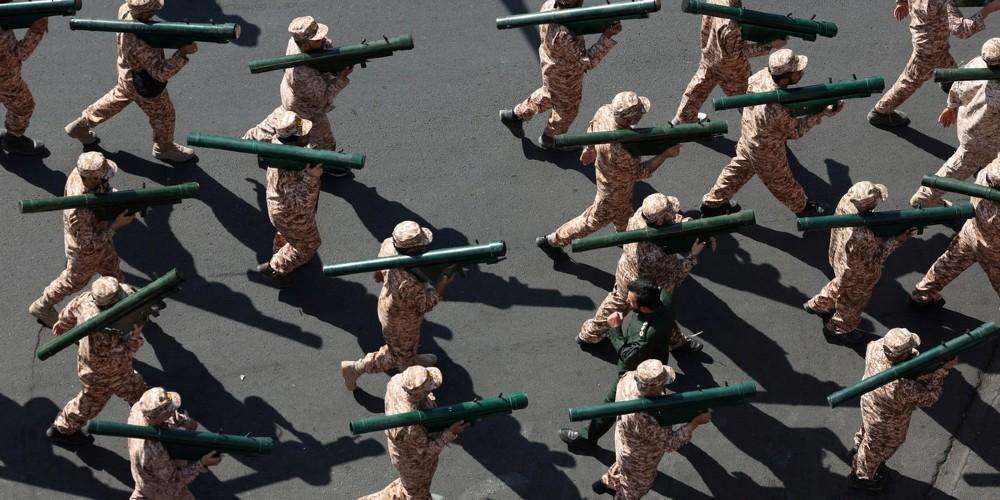
Iran’s military central command said on state media that any new attack would trigger sustained retaliation against U.S. bases and interests, as well as a threat to expand the conflict geographically.
“In the event of a new attack, in addition to changing the geography of the battle, new targets will be struck, and strategic weapons that have not yet been unveiled or used will be employed,” said Iran’s Islamic Revolutionary Guards Corps (IRGC) spokesperson Brigadier General Hossein Mohebb, as reported by Iranian state media outlet Tasnim News on Sept. 21.
Mohebb said that missile strikes are “directed solely at US military equipment and bases.”
Iranian state media outlet Mehr News reported that Iranian Parliament Speaker Mohammad Baqer Qalibaf said on Sunday that there will be no return to previous negotiations or reopening of the Strait of Hormuz until Iran’s conditions are met.
“Today the old American order in West Asia has collapsed, and it is the Islamic countries of the region that must implement a new order,” he said.
On Saturday, Yemen’s Iran-backed Houthi terrorist group launched missile and drone strikes at the Saudi capital, Riyadh.
Recent Houthi attacks have included strikes against Saudi energy infrastructure and civilian areas in Jazan, Abha, Khamis Mushait, and Najran, and near misses at the Muslim holy city of Mecca.
The U.S. State Department recently warned of the potential for unforeseen escalation in the Middle East, asking Americans in the region to exercise heightened vigilance.
“Do not travel to Iran for any reason. U.S. citizens should leave Iran now,” the alert issued on Sept. 19 states.
“This military conflict has the potential to escalate rapidly. Americans outside the Middle East should seriously reconsider travel to and through the region.”
The alert states that Americans should “be aware of potential flight cancellations, airspace closures, and travel disruptions” and encourages citizens to enroll in the Department of State’s Smart Traveler Enrollment Program.
Specifically, the renewed warning was related to attacks by the Iran-backed Houthi terrorist group in Yemen against targets in Saudi Arabia that included civilian airports.
“U.S. diplomatic facilities, including outside the Middle East, have been targeted,” the State Department warned.
“Iran and groups supportive of Iran may target other U.S. interests overseas or at locations associated with the United States and Americans throughout the world, including U.S. businesses and other institutions.”
Reuters, Melanie Sun, and Jack Philips contributed to this report.