(The Economic Collapse Blog)—A historic Treasury bond crisis has erupted and hardly anyone that doesn’t work in the financial world has any idea what is actually going on. We are literally witnessing the most dramatic financial crisis since 2008, and it isn’t even on the radar of most people in the general population. But it soon will be, because it is going to have tremendous implications for all of us. Economic conditions were very painful for several years after the financial chaos of the fall of 2008, and it appears that we are headed for a similar scenario now.
When average people on the street hear that bond yields are going up, most of them think that must be a good thing.
But bond yields and bond prices move inversely to one another, and so when bond yields are spiking that means that bond prices are crashing.
And when bond prices crash, that is not good at all.
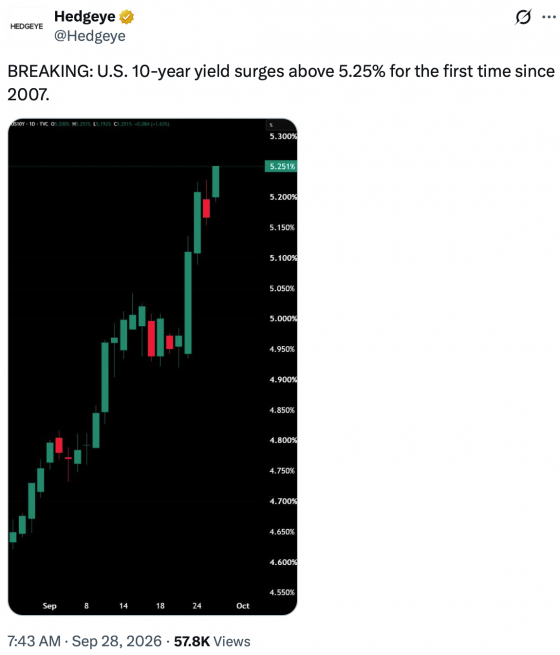
Investors were waiting to see whether or not the yield on 10 year U.S. Treasury bonds would smash through the 5 percent barrier, and that is precisely what happened.
Subsequently, investors have been closely watching the 5.25 percent barrier, because historically that is when market conditions really begin to go haywire…
When the yield on the 10-year U.S. Treasury bond rises well above 5.25%, the market landscape undergoes a marked shift. Subsequently, bond‑market volatility—and by extension, equity volatility and credit spreads—tend to increase substantially.
That means bonds are no longer a hedge against equities. The transmission chain unfolds in a tightly linked sequence: as U.S. Treasuries lose their appeal as portfolio‑hedging instruments, marginal buyers become more price‑sensitive, and the market’s responsiveness to capital flows intensifies; investors then turn to options to hedge U.S. Treasuries, driving up implied volatility—leading Treasury yields to rise first, which was precisely the official rationale the U.S. Treasury cited last month when it announced an expansion of its repurchase program (to safeguard Treasury liquidity).
Next, equity‑index volatility cannot remain unaffected: the mutual amplification of gains and losses between stocks and bonds will further destabilize rebalancing flows and push the VIX higher; rising demand for stock‑option hedging will also support implied volatility. The third channel is particularly critical today—bond‑market volatility has heightened uncertainty around discount rates for cash flows, while historically low cross‑stock correlations suggest that the market has scarcely priced in “long‑term interest rates,” the single most dominant source of factor risk.
I realize that all of that sounds quite complicated.
The bottom line is that when the yield on 10 year U.S. Treasuries climbs above 5.25 percent, stocks and bonds often start dropping together.
In other words, that level acts as a “line in the sand” beyond which everyone tends to panic.
Well, on Monday the yield on 10 year U.S. Treasuries hit 5.25 percent for the very first time since 2007…
Of course it isn’t just 10 year U.S. Treasuries that are the problem.
At this stage, yields on all long-term U.S. Treasuries are spiking…
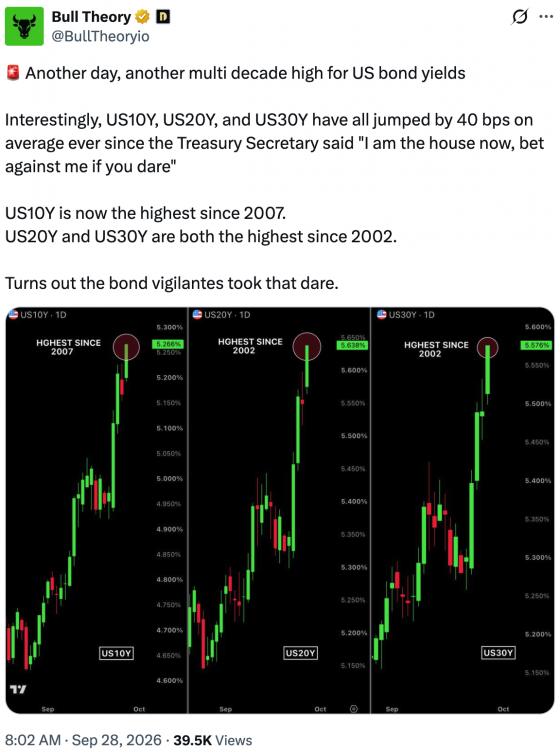
Bond charts are never supposed to look like that.
U.S. Treasuries are supposed to be among the most stable financial instruments in the entire world.
As I discussed above, when the yield on 10 year U.S. Treasuries reaches 5.25 percent, stocks and bonds often start dropping simultaneously.
At one point on Monday, U.S. stocks had lost a whopping $720,000,000,000 in value…
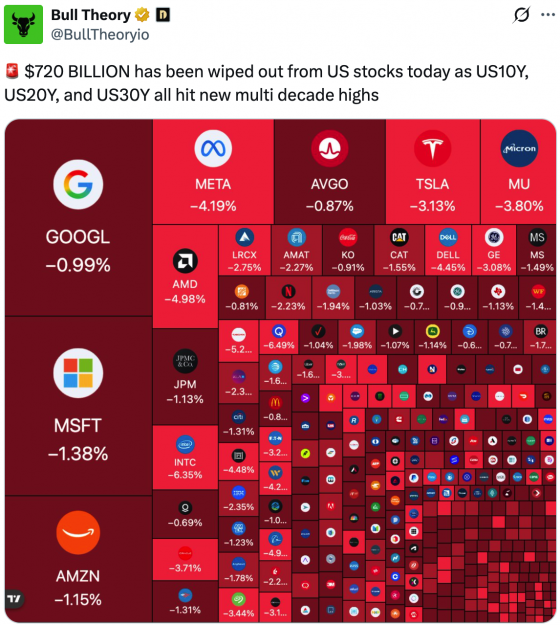
Thankfully, the markets have settled down a bit in the last couple of hours.
That is probably because there is some intervention going on behind the scenes.
But without a doubt, things are moving in a very troubling direction, and the consequences could be extremely severe during the weeks ahead.
Right now, our banks are holding vast amounts of U.S. Treasuries.
So when bond yields spike, the value of the U.S. Treasuries that they are carrying plummets.
There are a lot of banks that now have balance sheets that resemble a horror show, and that means that more bank failures are on the way.
In 2025, only two U.S. banks failed.
On Friday, we witnessed the sixth bank failure of 2026 so far…
ANOTHER BANK JUST FAILED…
California’s Nano Banc just failed. Shut down Friday. FDIC appointed receiver.
That makes SIX U.S. bank failures this year, versus two in all of 2025.
California cited years of mismanagement at Nano. Beyond this bank, I’m watching lenders heavily exposed to commercial property.
The FDIC itself has flagged high interest costs and vacant buildings making property debt harder to refinance and repay.
If borrowers can’t pay, losses eat through bank capital. That’s how more failures could follow, one balance sheet at a time.
They like to quietly announce these bank failures on Fridays so that they get as little attention as possible.
Unfortunately, if bond yields continue to soar they won’t be able to contain the panic for long as one bank after another comes apart like a 20 dollar suit.
In addition, rising bond yields could potentially set the stage for a nightmarish derivatives crisis.
Interest rate derivatives are the biggest segment of the derivatives marketplace by a a very wide margin, and if interest rates move up fast enough it could cause a cascading wave of defaults.
Let me put it another way.
If interest rates rise with sufficient velocity, rapid mark-to-market shifts can outpace liquidity buffers, threatening a systemic chain reaction of counterparty failures.
And that would be a massive disaster.
Rising interest rates will also have an enormous impact on U.S. consumers.
The national average for a 30 year fixed-rate mortgage has already jumped above 7 percent.
That is considered to be an extremely important psychological level.
Very few potential homeowners want to pay 7 percent, and home sales are likely to be depressed even more than they have been.
Meanwhile, credit card rates are going to go up, and auto loans are going to become a lot more expensive.
Collectively, all of this is going to slow down economic activity.
Economic activity was already starting to slow down thanks to the global energy crisis, and rising rates will just intensify that slowdown.
This is going to be such a catastrophe.
We are potentially facing a financial crisis and a major economic slowdown at the same time.
If that sounds a lot like 2008, that is because it is a lot like 2008.
Meanwhile, we are forced to deal with a global energy crisis, a global fertilizer crisis and a Super El Niño.
On top of everything else, World War III is raging on the other side of the planet.
Decades of bad decisions have brought us to this point, and now we all get to pay the price.
Michael’s new book entitled “10 Prophetic Events That Are Coming Next” is available in paperback and for the Kindle on Amazon.com, and you can subscribe to his Substack newsletter at michaeltsnyder.substack.com.