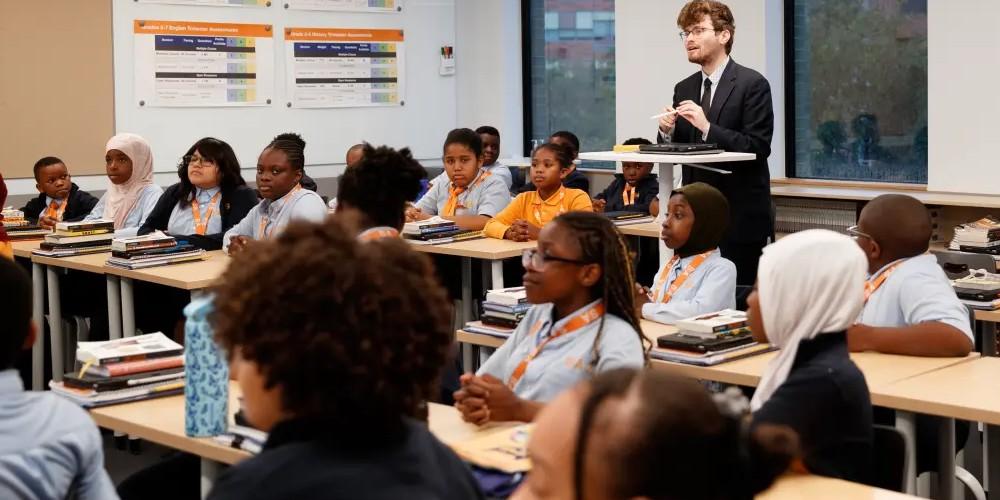
A six-story campus with six dance studios, a rooftop field, a 300-seat auditorium, ceramics rooms and a two-story gym just opened in the South Bronx. It is not a private school for the children of hedge-fund managers. It is the first ground-up building for Success Academy, and it serves 2,400 kids admitted by lottery, not by entrance exam or family connection.
Founder Eva Moskowitz put it in the poorest congressional district in the nation on purpose.
She has spent twenty years proving the same point. The network of 22,000 students, overwhelmingly black and Latino and from low-income families, just ranked first in New York State in both math and English language arts proficiency for grades 3-8. Ninety-seven percent proficient in math. Ninety-two percent in reading. That beat Scarsdale and every other wealthy suburban district the state could throw at them. For nine straight years every graduating senior has been accepted to a four-year college. More than a thousand of them.

Middle-schoolers work LSAT logic problems. High-schoolers take up to five AP classes. Second-graders study logic. Students start the day at 7:30 a.m. and stay until 4:30 p.m. Co-curriculars (dance, chess, theater, sports, art) are treated as equal to academics, not as after-school luxuries reserved for the affluent. Teachers call parents starting at 6:45 a.m. if a child is late. Excessive absences can mean repeating a grade. The principal finds kids already lined up when she arrives at 6:30 a.m.
Classical music replaces the bell. Kids move quietly between rooms.
“There’s nothing wrong with the children,” Moskowitz told the New York Post. “There’s something wrong with the system that fails to deliver for kids and families now going on a half-century.”

She is a liberal Democrat who sent her own children to the school and still insists on phonics from day one. “Any educator worth their salt knows that kids need phonics to learn to read. You will fail to teach kids to read if you don’t teach phonics.”
The Money Excuse Does Not Survive Contact with Reality
New York City already spends somewhere between $36,000 and $38,000 per pupil each year. The national average sits near $18,000. Success Academy built this campus for $245 million, roughly 43 percent of what the School Construction Authority would have spent on a comparable public building, because it is not bound by the same thicket of union rules and bureaucratic process.
The argument that the problem is insufficient funding collapsed years ago. The argument that the problem is the children never had evidence to begin with.

Principal Shannon Beatty put it plainly. “It’s possible to not only have high standards, but also to insist that kids can meet those standards. Right now, that belief is what’s lacking in other schools.”
Moskowitz adds that kids do not emerge from the womb caring about musical success, athletic success or academic success. Adults have to build a culture in which winning and achieving is pleasurable. That culture is missing in the monopoly system that has been failing the same neighborhoods for decades.
The Monopoly Does Not Like Competition
Teachers’ unions and the elected officials who do their bidding have treated Success Academy as an existential threat for two decades. They have sued over shared buildings and over the creation of new charters. Moskowitz calls it “a battle royale” against a monopolistic system.

The latest skirmish involves a separate charter transfer to a school run by her husband. The United Federation of Teachers and its state affiliate moved quickly to block it in court. When results keep showing that high expectations, orderly classrooms and actual phonics produce college-bound students in the South Bronx, the political response is rarely to copy what works. It is to limit the number of schools that can try it.
Students at the new campus commute as far as two hours each way. One high-school junior who has been in the network since third grade called the building itself a daily highlight. “It’s the first time we’re having a whole school to ourselves.”
That is what happens when someone decides children deserve a building like this and then actually builds it. Moskowitz is right that we do not have to accept educational dysfunction. Morally we cannot afford to.

Study to shew thyself approved unto God, a workman that needeth not to be ashamed, rightly dividing the word of truth.
The same standard of diligence applies to how we teach the next generation. The results in the Bronx already show what is possible when adults stop making excuses and start expecting excellence. The only remaining question is how long the monopoly will be allowed to keep children from it.