
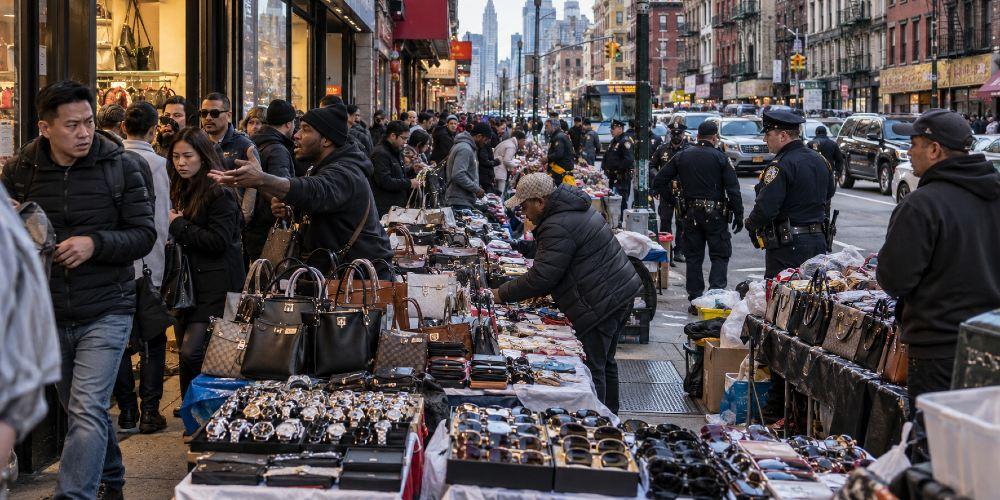
Walk four blocks of Canal Street from Centre Street to Broadway and you are not in Manhattan anymore. You are in an open-air knockoff bazaar. Tables and rugs have swallowed the sidewalk. Pedestrians get a five-foot sliver. Fake eighty-dollar Rolexes, two-hundred-fifty-dollar Dior bags, and twenty-dollar Prada sunglasses sit out in the open like City Hall handed out permits.
Nobody did. The sellers are back anyway.
The New York Post spent Thursday and Friday on the stretch and watched the same farce the neighborhood has lived with for years. A vendor smacked a reporter’s phone, screamed at her to get out, and drew a harassment citation. Not a vending arrest. Other sellers closed in and started yelling. On Thursday around 4:20 p.m. an officer wrestled one man between two cars after he tried to slip away shouting, “You didn’t see me selling nothing!” At least two more arrests happened that afternoon. Then the rugs come back out.
Law-enforcement sources told the Post their hands are tied by New York’s revolving-door justice. They called it whack-a-mole. Sweep the block, write a summons or a desk appearance ticket, and the same trade is open the next morning. One source put the math in plain English. Solving it with cops would mean flooding the zone every day, and then the market just moves to City Hall, the Brooklyn Bridge, Midtown, and on down the list. Another source said the quiet part out loud. Nobody is dying over it, so there is no appetite for aggressive criminal enforcement. Catch and release is the policy.
“No one is dying over it so how do you create the appetite for aggressive criminal enforcement? There is none. That’s why it’s catch and release.”
Scripture already named this habit. “Because sentence against an evil work is not executed speedily, therefore the heart of the sons of men is fully set in them to do evil.” Ecclesiastes 8:11. Delay is not neutral. Delay is an invitation.
The numbers City Hall already has
This is not a mystery the mayor just discovered. So far this year the NYPD has made 88 arrests on Canal, issued 335 summonses, confiscated more than 10,000 bags of peddler property, and seized 66 vehicles tied to the trade, a department spokesperson told the Post. A June operation recovered bootleg goods the police valued at $151 million. The Department of Sanitation, which backs the NYPD when setups block doors or turn filthy, has issued 5,870 summonses and warnings to street vendors this year, a 17 percent jump the agency tied to more 311 complaints.
None of it stuck. A July raid cleared the sidewalk and, half an hour later, the merchants were back in business. Federal agents stormed the street in April. Same result. Sellers drop the bags, sprint the block, and wait for the uniforms to leave. Wellington Chen, executive director of the Chinatown Partnership Local Development Corporation, has watched the loop long enough to stop pretending it is enforcement.
“It’s a game of cat and mouse. You put pressure on one corner and they move down to the other corner, and the next morning they’re back.”
Chen also said what every storefront on that stretch already knows. On some blocks you cannot pass. You wait for strangers to squeeze by. Law enforcement shows up, the sellers dash, and the city does the same thing again and expects a different morning. Desk tickets do not mean much when the confiscated pile is a drop in the bucket. He wants the legislature to change the rules. He is right that a ticket nobody fears is theater.
Sajib Datta, who works at the nearby Loknath Gift Shop, has a simpler complaint. Vendors block the door. Her boss calls the police. Buyers pay no tax. The city loses the money, and the legal shop eats the mess. “I think it should stop.”
Mamdani picked a side and it was not the sidewalk
The political half of this story is not subtle. After winning the election, Mayor Zohran Mamdani put out a video attacking immigration operations on Canal Street and telling New York immigrants to “stand up to ICE.” Elected officials later wrote that the illegal merchant problem got worse after the democratic socialist took over.
That posture did not start on inauguration day. When federal agents hit the knockoff trade in October 2025, Fox News reported nine illegal aliens from Senegal, Mali, and Guinea arrested for allegedly selling counterfeit goods, plus protesters accused of blocking officers. Mamdani, then a candidate, called the operation aggressive and reckless. By February, judges had ordered several of those West African migrants released, one of them calling an arrest blatantly unlawful. The message that traveled back to the rugs was not complicated. Fight the raid. Beat the case. Set up again.
On January 14, city and state lawmakers wrote Mamdani and NYPD Commissioner Jessica Tisch and asked for a real answer from the NYPD, the Department of Worker and Consumer Protection, and Sanitation. Entrances to shops and apartment buildings were blocked. Residents and small businesses faced regular harassment and, in some cases, alleged physical assaults. Mamdani would not say the police should be out there clearing the vendors. He went after ICE instead.
City Hall spokesman Sam Raskin offered the sentence every failing administration keeps in a drawer.
“Addressing the quality-of-life issues on Canal Street is a priority for the Mamdani administration and we are committed to using a whole-of-government approach to doing so.”
A whole-of-government approach that leaves four blocks of sidewalk to counterfeit dealers is not an approach. It is a press release. Trademark counterfeiting is a real offense. Blocking a legal storefront is a real harm. Smacking a reporter’s phone is a real crime, and even that produced a citation while the fake sunglasses stayed in the game. The people who live and work on Canal are not asking for a slogan. They are asking the city to prefer the shop that pays taxes over the rug that does not.
One local told the Post the street no longer looks like Manhattan. It looks like the seedier blocks of Bangkok. That is the compliment a sanctuary city earns when it treats removal as the scandal and the open-air theft market as a neighborhood quirk. The cops can keep playing whack-a-mole. The mole already knows the rules.