The Islamic Revolutionary Guard Corps tried to hit an American aircraft carrier and a guided-missile destroyer on Saturday. They missed. Three of their oil tankers are now wreckage.
That is the whole transaction. Tehran took a shot at the United States Navy in what CENTCOM called multiple unprovoked ballistic-missile attacks. No American sailor was harmed. Washington answered by disabling two crude carriers and erasing a third.
The ships were not random hulls bobbing in the Gulf. They were part of the multibillion-dollar shadow fleet that keeps the IRGC and its proxies in cash. One of them sat off Kharg Island, the rocky export hub that used to move about 90 percent of Iran’s crude. Another sat near Jask. The third, empty of oil, was in the Gulf of Oman when American forces told the crew to get into the lifeboats and then tore the vessel apart.
Three Minutes, Then Fire
Video obtained by Iran International and reported by the New York Post captured the radio traffic before the missiles flew. A U.S. aircrew warned a tanker near Kharg that it had three minutes to clear the crew. “This was your final warning.” “Get into your lifeboats and abandon the ship immediately.”
On one of the targeted ships, crewmen could be heard speaking Persian and Urdu and asking whether the captain was at his post. He was still asleep. That is the regime in miniature. A terror army that fires ballistic missiles at American warships and cannot even keep its own skipper awake while the cash ship burns.
Iranian state media at Tasnim claimed four missiles hit a tanker anchored about six miles from Kharg and said there were no casualties as the crew evacuated. Fine. The point was never the deckhands. The point was the floating ATM.
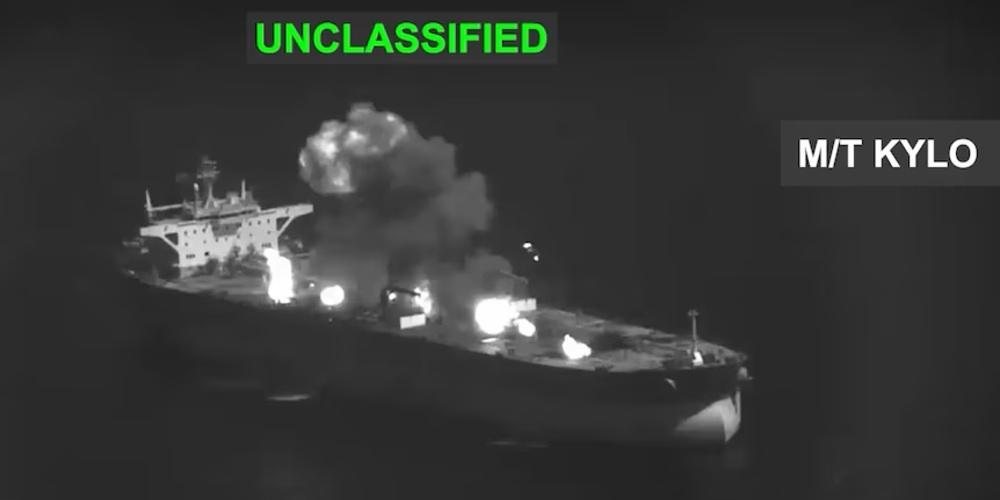
CENTCOM named the targets. Forces permanently disabled the IRGC crude carriers M/T Downy off Kharg Island and M/T Stark 1 near Jask. They completely destroyed the unladen M/T Kylo, also known as the Noxen, after ordering the crew off. Iran, the command noted, has no means by which to defend those ships.
Let the message to the IRGC be clear. If you shoot at two of our ships, we will impose an even higher economic cost — taking out three of yours. We will not hesitate to defend American forces, and if necessary, destroy Iran’s limited and exposed oil fleet.
That was Adm. Brad Cooper, the CENTCOM commander. Secretary of War Pete Hegseth put it even plainer on X.
It’s simple. If Iran shoots at US ships, we will destroy (and sink) their oil tankers. All they have to do is not shoot at US Navy.
For he is the minister of God to thee for good. But if thou do that which is evil, be afraid; for he beareth not the sword in vain. For he is the minister of God, a revenger to execute wrath upon him that doeth evil.
Romans 13:4 is not a metaphor. A navy that will not answer fire is not a navy. It is a target.
The Island That Pays for the Terror
Kharg is not scenery. It is the regime’s wallet. Pipelines from the mainland feed a terminal that can load millions of barrels a day. For months the United States has been squeezing that wallet with a naval counter-blockade, sanctions, and what Treasury has treated as an economic siege. Iran is already down to roughly two months of fuel by some official admissions. China’s crude take from Tehran has already been hammered. The shadow fleet is what is left.
That is why Saturday matters more than another round of Gulf fireworks. The first American strike on Kharg back in March hit about 90 military targets and deliberately spared the oil works. Trump has since posted about the island being blown to smithereens and has refused to take a seizure off the table.
Tehran vowed a “strong response” if the critical infrastructure itself were touched. Saturday was not a full raid on the terminal. It was something colder. The ships that turn Kharg’s crude into IRGC money were put on the ledger.
ZeroHedge called the ratio what it is. Three for two. Shoot at a carrier group, lose three cash ships. The IRGC still has proxies, mines, and a habit of calling every American act “terrorism” on Telegram. What it does not have is an unlimited fleet, an unlimited buyer list, or an unlimited store of gasoline at home.
The talking heads will now worry about “escalation.” They always do, usually after Iran has already fired. The carrier and the destroyer evaded the missiles. American crews walked away whole. Three tankers that bankroll Hezbollah, the Houthis, and the rest of the IRGC’s regional murder network did not. That is not a spiral. That is a price list.
Iran can stop shooting at the United States Navy any time it likes. Until then, the arithmetic is public. Two ships of ours. Three of theirs. And the fleet that funds the Guard is, as Cooper said, limited and exposed.