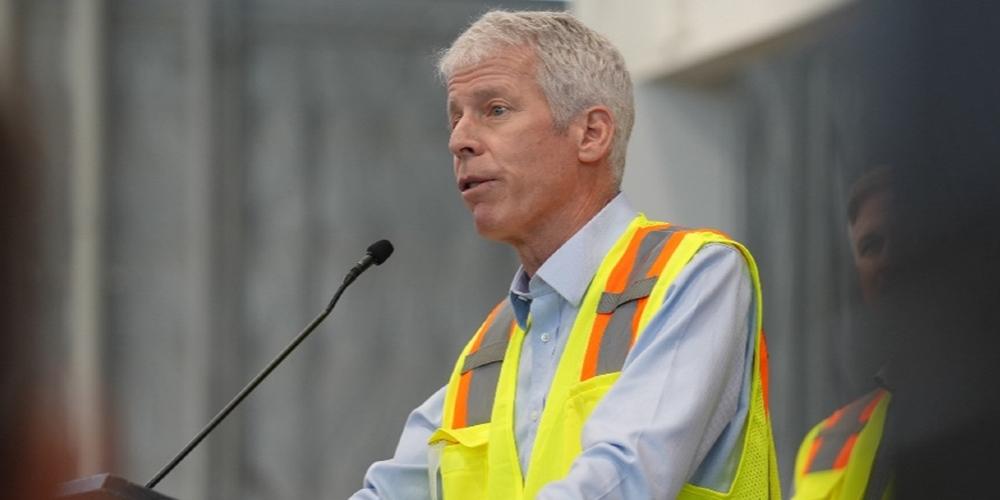
 (DCNF)—Secretary of Energy Chris Wright outlined America’s long-term goal for securing global trade passing through the Strait of Hormuz even as its conflict with Iran threatens such traffic.
Wright touted the sustained traffic transiting the Strait of Hormuz before telling Dana Bash during a “State of the Union” interview Sunday that securing the passageway “shouldn’t be just the United States’s responsibility” looking forward. His appearance on the CNN show comes the day after U.S. Central Command (CENTCOM) forces reported taking out three Iranian oil tankers.
“The president says the Strait of Hormuz is under U.S. control. Just yesterday, the U.S. struck three Iranian tankers in retaliation for Iran firing missiles at U.S. warships. Meanwhile, The New York Times reports that Iran struck at least 23 merchant ships in the Strait in the last two months,” Bash said before asking Wright, “Does that sound to you like it’s a situation completely under control?”
“Our transits through the Strait are averaging over 9 million barrels a day now. And with the access pipelines that go around the Strait, we’re probably two-thirds or more of pre-conflict flows,” Wright responded. “So Iranians are still causing trouble, but the United States Navy is winning that battle.”
Bash then asked Wright if he is suggesting that the U.S. Navy is going to have to stay in the Strait “indefinitely” to maintain the current flow of oil and tankers.
“Oh, I think we’ll see a change in the Iranian regime, or certainly a change in their policy if they want to become a trading nation again and engage with the world,” Wright said. “But they have not lightly given up their nuclear weapons program.”
In parallel with military operations, the U.S. Department of the Treasury launched Operation Economic Outcast on Aug. 24 to sanction those who trade with Iran.
“Thank God for President Trump‘s courage to take this on,” Wright continued. “He did not want to kick the can down to the road to the next administration to deal with a nuclear-armed Iran. This is Iran without nuclear weapons; imagine Iran with nuclear weapons.”
Bash then doubled down, asking if the U.S. Navy being in the Strait is “just the new normal now?”
“Well, it is today, but I think, as you look forward, other nations will come and work with us in this endeavor,” Wright responded. “Certainly, trade for the world is important. It shouldn’t be just the United States’ responsibility. But until Iran changes their position or changes their government, we’ll have to deal with them. But, slowly, their capabilities are being degraded and ours are being enhanced.”
Bash then told Wright that “what’s unsaid in this discussion so far is that it’s just— it’s not safe.”
“The New York Times also says August was the deadliest month for merchants in the Strait of Hormuz since March,” she continued before asking Wright if he can “unequivocally say that ships that want to transit through the Strait of Hormuz can do so safely?”
“We‘re working cooperatively with fleets that do want to transit,” Wright said. “Some ships aren’t transiting, and, of course, that’s their choice, but the United States is working with teams from all the nations in the Gulf to get transits and to continue to ramp them up. Iranian ships, of course, are not transiting at all. That’s a ticking time bomb for the economy of Iran.”
“But look, we’re trying to end a 47-year conflict as Iran dashes to develop nuclear weapons and wreak havoc on their neighbors and threaten the world economy,” he later added. “Is there some effort involved in that? Why, of course.”
All content created by the Daily Caller News Foundation, an independent and nonpartisan newswire service, is available without charge to any legitimate news publisher that can provide a large audience. All republished articles must include our logo, our reporter’s byline and their DCNF affiliation. For any questions about our guidelines or partnering with us, please contact [email protected].