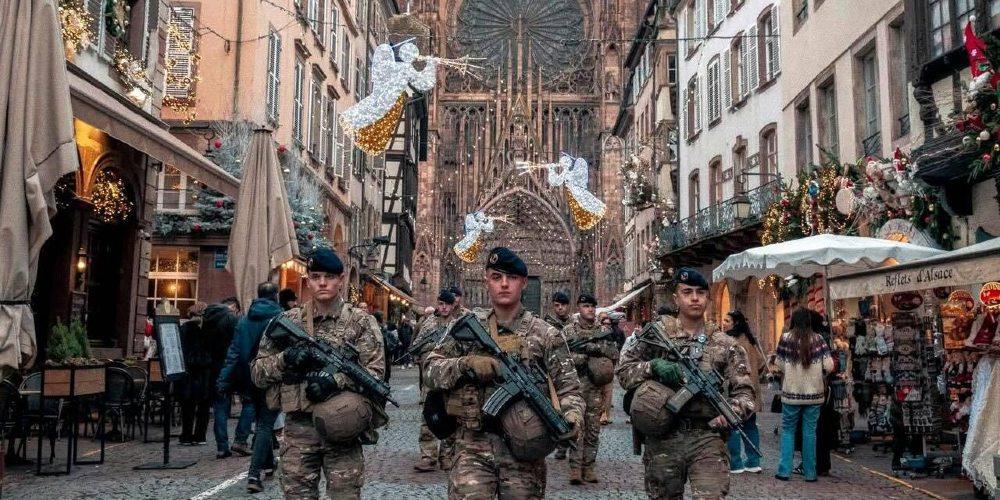
(Zero Hedge)—French soldiers will take over guard duty so that police and gendarmes can be moved onto the streets for Saturday’s expected protests, Interior Minister Laurent Nuñez told parliament on Tuesday.
Nuñez said troops from Operation Sentinelle, the anti-terror deployment, would replace internal security forces mainly on static guarding duties. Prime Minister Sébastien Lecornu said the same day that Saturday’s mobilization of forces “will be massive,” Remix News reported, ahead of a major protest planned for October 24.
Sentinelle was launched in January 2015 and keeps about 10,000 soldiers across France to guard against terrorist attacks, usually at places of worship, schools, tourist sites, railway stations and airports. It also covered the Paris 2024 Olympics and Paralympics. Nuñez described a post-holding role for the troops in this case, not a crowd-control one.
The government now admits it failed to contain last Saturday’s riots. Lecornu acknowledged lapses in intelligence gathering, said police had been positioned too rigidly and said authorities chose not to cancel planned police leave, Reuters reported. He blamed far-left groups and framed the crisis as a choice “between violence and the Republic”; those groups say the government underestimated anger over living costs and declining public services. Nuñez told parliament: “I deeply regret what happened. I accept my share of responsibility.” He offered his resignation, and Macron rejected it.
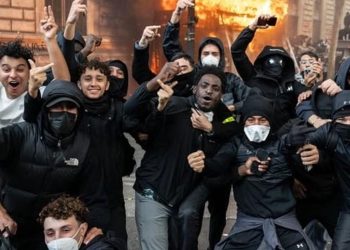
About 60,000 police and gendarmes were on duty nationwide on Saturday, October 17, when roughly 500,000 people marched against the cost of living (authorities told Remix 550,000; organizers claimed over 800,000). Nuñez called that too few for the large crowds of rioters and looters on the edges of the marches. He said police had “lost control” in some cities and admitted a “lack of anticipation.” Riots and looting hit Paris, Marseille, Lyon and other cities, and in Limoges an arson attack brought down the roof and tower of the historic town hall.
The toll so far is large. Euronews counts more than 2,500 arrests and Remix more than 2,400 detained, while Justice Minister Gérald Darmanin put the number in custody at over 2,330, 70% of them adults. Almost 1,000 members of the security forces were injured. Alain Di Crescenzo, president of the chamber of commerce, said more than 2,000 shops were hit and put the damage at “hundreds of millions of euros.” On Monday Lecornu asked regional authorities for “localised and partial curfews” and said nearly 200 Paris police investigators would comb footage to identify looters. Parliament is also setting up a commission of inquiry into the causes of the unrest. As we reported, 8 p.m. curfews followed in northern cities.
Nuñez is also considering banning demonstrations that have not been declared and could lead to public disorder. Declared marches could be caught too, he said, but only if organizers or their stewards give authorities reason to think things will get out of hand. For marches judged low-risk, routes should steer clear of public buildings and high streets, and intelligence services are to step up estimates of turnout, especially of the most radical participants. He said security forces need more “responsiveness and mobility” against “scattered” and “extremely mobile” groups, and told parliament: “We will be there.”
The playbook has a precedent. In March 2019, for the 19th Saturday of the yellow vest protests, Sentinelle troops guarded sensitive sites so police could focus on order, and demonstrations were banned on the Champs-Élysées and in central districts of Bordeaux, Toulouse, Marseille, Nice and Rouen. Police made 31 arrests and issued 15 fines for entering banned areas, out of 2,322 street checks in Paris, NBC News reported. Macron brushed off opposition criticism of the army’s involvement: “Those trying to scare people, or to scare themselves, are wrong.”
Ministers of that period drew a line at confrontation. Armed forces minister Florence Parly said it was “hors de question” to put soldiers face to face with protesters, and said Sentinelle would relieve police and gendarmes of counter-terrorism tasks. Nuñez’s description of static duties fits that model, though the government has not said where in the country the troops will be posted.
The unrest is also reaching the bond market. We reported this week that French 10-year yields hit 24-year highs near 5%, with the spread over German Bunds close to 160 basis points and Moody’s due to review France’s Aa3 rating, which carries a negative outlook. Earlier, we described the country as entering a “point of no return” as the riots spread.