
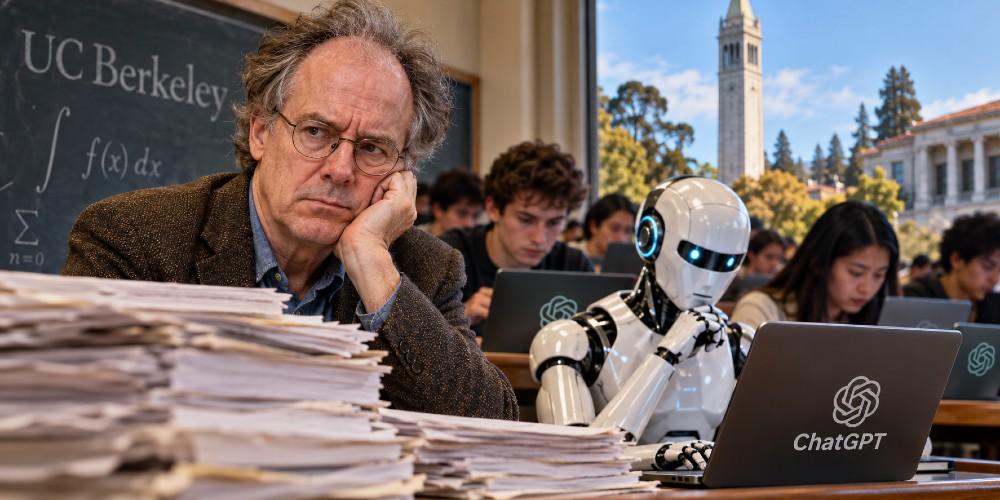
A mathematician who won one of the highest prizes in his field has looked at his students’ homework and decided the whole exercise is a waste of time. Richard Borcherds, the UC Berkeley professor who received the Fields Medal in 1998, no longer checks whether the answers are right. He just checks whether something got turned in.
As he told the Daily Californian, there is “no point” in paying graders to evaluate work that artificial intelligence tools can now produce at a level that earns top marks.
The New York Post reported on the shift after Borcherds spoke with the campus paper. Student use of AI for homework is now widespread, he said. Grading for correctness creates a massive incentive to outsource the thinking and penalizes the rare student who still tries to do the work himself. Online exams have become “a waste of time” for the same reason. Average scores jump when the machines are available and no one can reliably tell who is using them.
“If AI continues to improve at present rate, then, in a few years, there’ll be nothing human mathematicians can do that AI can’t do better.”
Borcherds made that prediction in the same interview, right after OpenAI announced that a swarm of its agents had produced a Lean-formalized proof resolving key statements of the Navier-Stokes existence and smoothness problem—one of the Clay Mathematics Institute’s long-open Millennium Prize questions. He compared the moment to earlier technological displacements.
Looms ended hand weaving. Motor cars replaced horses. Nothing like this has hit mathematics before. Five years ago the profession looked relatively safe from automation. Now he has no idea what to tell undergraduates who want to pursue it. He even asked ChatGPT the same question. The chatbot, he said, had no idea either.
That last detail is almost too on-the-nose. A Fields medalist is consulting the machine about whether young people should still bother learning the subject the machine is rapidly mastering. Meanwhile the university’s official response has been to require faculty to put some kind of AI statement in their syllabi and to leave the actual rules to individual instructors.
Berkeley tested detection tools including Turnitin and Rumi and decided they were not reliable enough for campus-wide use. So the policy is basically a shrug. Students know it.
This is not happening in isolation. Earlier this year the New York Post covered soaring failure rates in introductory computer science courses at the same school. Professors blamed heavy reliance on large language models. Students aced take-home work then collapsed on exams because they had never built the underlying skill. Another Berkeley mathematics professor, Zvezdelina Stankova, wrote an op-ed arguing that many of her students arrived five to eight years behind on basic algebra and fractions; the New York Post later noted that she had used AI tools to help edit the piece.
The pattern is consistent. Standards eroded for years under pressure for equity and open access. AI arrived and accelerated the collapse of any remaining expectation that students would actually master the material.
Borcherds himself admits the new completion-only approach is “not a very good system.” He simply sees no workable alternative while AI remains ubiquitous and detection remains unreliable. Academic inertia will probably keep the department looking roughly the same for a couple of years, he added, even as the ground shifts underneath it.
That is the polite version. The blunter version is that elite universities spent decades lowering the price of admission and the rigor of the curriculum. They are now discovering that a credential earned with machine assistance is worth approximately the paper it is printed on—if anyone still prints it.
Scripture describes the condition with uncomfortable precision. “Ever learning, and never able to come to the knowledge of the truth.”
Students can generate perfect problem sets and polished essays without ever wrestling with the ideas. They accumulate credits and degrees while remaining unformed. The workman who studies to show himself approved has been replaced by the student who prompts a model and submits the output. Diligence, honesty, and the slow formation of judgment were never optional extras. They were the point. When a university stops requiring them, it stops doing the thing it claims to exist for.
None of this requires panic about superintelligence or apocalyptic forecasts. It requires ordinary clarity. A society that outsources its thinking will eventually discover it has nothing left worth protecting. Berkeley’s Fields medalist has already decided the old homework system is pointless. The rest of us should ask whether the degrees built on that system are headed the same way.