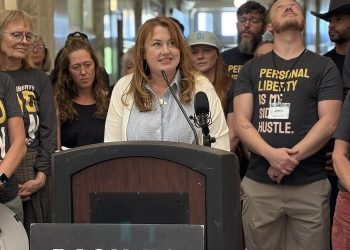

When confronted with the Democratic Socialists of America’s explicit blueprint to dismantle the Senate, subordinate the presidency, and reshape the Supreme Court, leading House Democrats offered little more than shrugs, denials, and claims of ignorance. This evasion reveals a deeper truth: the radical left’s long march through America’s institutions has reached a point where even mainstream Democrats hesitate to distance themselves fully from calls to rewrite the Constitution itself.
The DSA’s newly updated “Workers Deserve More” platform does not mince words. It demands a unicameral legislature by abolishing the Senate, replacing the presidency with a parliamentary-style executive chosen by and accountable to Congress, and fundamentally altering the judiciary.
Additional planks include abolishing ICE, ending all deportations, granting voting rights to noncitizens and felons, and defunding what they derisively term the “Department of War.” These proposals are not fringe musings; they form the litmus test for DSA endorsement of candidates seeking to run as Democrats.
Rep. Ro Khanna of California, pressed on the plan, offered a tepid “I don’t support that” while admitting he hadn’t read it. Rep. Ilhan Omar dodged entirely, citing non-membership. Rep. Pete Aguilar insisted he wasn’t worried about the socialist wave and looked forward to collaborating with all Democrats, no matter how extreme.
This reluctance to condemn exposes the growing capture of the Democratic Party by its most radical elements. Recent primary successes by DSA-backed candidates have already sent shockwaves, with socialist victories in New York serving as a warning to party leadership. While figures like Hakeem Jeffries downplay the shift, the institutional momentum favors those who view the American system not as a safeguard of liberty but as an obstacle to be demolished for their vision of equity.
The Constitutional Reckoning
America’s Founders designed the Senate to protect smaller states and provide stability against fleeting majorities. The presidency ensures energetic execution of laws, and the Supreme Court stands as a check against legislative overreach.
The DSA’s agenda would consolidate power in a single legislative body dominated by population centers, effectively silencing vast swaths of the country. This is not reform; it is the substitution of a republic for a pure majoritarian democracy, where transient passions could override enduring principles.
Such proposals echo historical warnings about concentrated power. The left’s discomfort with the current structure stems from repeated failures to bend it fully to their will—whether through court packing schemes or statehood maneuvers aimed at tilting the Senate. Their frustration with constitutional guardrails reveals a profound impatience with the consent of the governed when that consent does not align with progressive orthodoxy.
Ironically, the same voices decrying “threats to democracy” now champion structural changes that would erode the federalist balance and checks and balances that have preserved liberty for generations. One need not look far into history to see where such experiments lead: centralized power promising utopia but delivering control and diminished freedoms.
Immigration Radicalism and National Sovereignty
The DSA’s domestic overhaul pairs with extreme immigration demands—abolishing border enforcement, mass amnesty including for criminals, and extending voting rights to noncitizens. These positions accelerate the demographic and cultural transformation already straining American communities. House Democrats’ unwillingness to reject this outright suggests a party increasingly comfortable with open borders as a path to political dominance rather than a humanitarian concern.
Critics rightly note that rewarding illegal entry while stripping away law enforcement tools undermines the rule of law. When combined with efforts to nationalize key industries and impose wealth taxes, the agenda paints a picture of a command-and-control economy antithetical to the free enterprise system that built American prosperity.
A Biblical Foundation Under Siege
In the face of such upheaval, Scripture offers timeless clarity. As the Apostle Paul warned the church at Thessalonica, “For the mystery of iniquity doth already work: only he who now letteth will let, until he be taken out of the way” (2 Thessalonians 2:7, KJV).
The erosion of ordered liberty and the push toward centralized, unaccountable authority reflect the ancient human temptation to reject God-given limits in pursuit of earthly power.
Conservatives have long argued that the American experiment rests on a moral and constitutional foundation. When institutions designed to protect individual rights and diffuse authority come under attack from within, the response cannot be accommodation but a firm recommitment to first principles.
The DSA’s platform and Democrats’ awkward dance around it should serve as a clarion call. America does not need a parliamentary overhaul or the abolition of its upper chamber. It needs leaders who defend the framework that has secured liberty longer than any other in modern history. The coming elections will test whether voters recognize the stakes before the radicals’ vision advances further.