The Supreme Court told the Trump administration on Monday that the midterms will be run on the same mail-ballot machinery that has been driving half the country crazy since 2020. Standardized envelopes, unique barcodes, and a list of who is actually supposed to receive a ballot? Not this year. Maybe later.
That is the practical meaning of the unsigned emergency order. The justices left standing the nationwide blocks on the Postal Service’s Ballot Mail for Federal Elections rule. Fox News and The Gateway Pundit both reported the denial of the stay. Alabama, North Carolina, and Wisconsin have already started stuffing envelopes. The rest of the country will follow under the old rules.
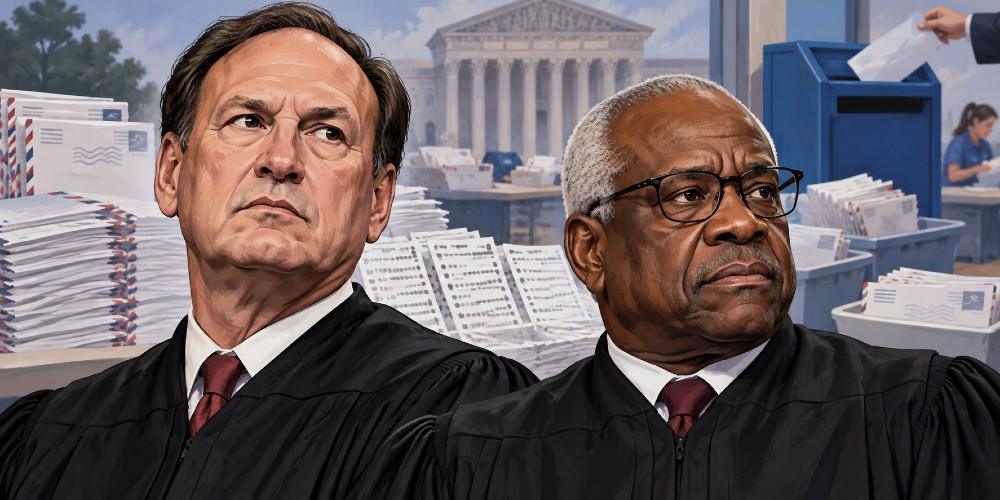
Justice Samuel Alito, joined by Justice Clarence Thomas, dissented. Alito wrote that the Court “incorrectly denies the Government’s application for a stay of a universal injunction” and that the administration “is likely to succeed on the merits of its appeal.” Two justices still believe the executive can tell the Postal Service how to handle federal election mail. The rest of the Court would rather wait until the votes are already in the pipeline.
What the Rule Actually Did
This did not come out of nowhere. President Trump signed Executive Order 14399 in March. The Postal Service published the implementing rule in August. The requirements were not mystical. States would have to use Postal Service-approved outbound and return envelopes with unique barcodes and upload the names of mail-ballot recipients into a federal portal. The Service could refuse to carry ballots for states that would not play along.
In other words, stop treating millions of federal ballots like anonymous greeting cards. Know who requested them. Track the package. Do not deliver a stack of ballots into a system that cannot even say, in real time, who is on the list.
Democratic attorneys general and the usual voting-rights outfits sued. They called it an attempt to “virtually eliminate mail voting on the eve of a major election.” That is a slogan, not a description. Requiring a barcode is not a ban. Requiring a list of recipients is not a poll tax. It is the minimum you would demand of any other high-value shipment in America.
U.S. District Judge Indira Talwani in Boston, an Obama appointee, issued a preliminary injunction on September 4 after an earlier freeze. The First Circuit refused to lift it. Then, late Sunday, Trump-appointed Judge Carl Nichols in Washington issued his own block.
Breitbart and the New York Post covered Nichols’ turn. He had previously said the challenge was premature. With ballots already moving, he decided key portions of the rule exceeded the Postal Service’s authority and that the government had not shown “significant fraud” sufficient to prove irreparable harm.
Read that last part twice. The standard for cleaning up federal mail is now “prove the next theft before we let you lock the door.”
Kavanaugh Left the Door Cracked
Justice Brett Kavanaugh concurred in the denial, and that concurrence is the part the wire services will bury. He wrote there is “at least a fair prospect that the final rule falls within the Postal Service’s statutory authority.” He just would not let it apply to 2026 because state and local officials, in his view, do not have enough time. Applying it now would be “arbitrary and capricious” under the Administrative Procedure Act.
So the legal theory is not dead. The calendar is. That is a very particular kind of defeat. The Court did not say the president may never use the mails to protect a federal election. It said the judges will not let him do it while early voting is already underway.
Election officials and a handful of Republican secretaries of state, including Georgia’s Brad Raffensperger, had already asked the Court to keep the old system for November. Their argument was logistics. Envelopes were ordered. Staff were trained. Military and overseas ballots have a statutory ship date. Fair enough as an operations complaint. It is a terrible argument if the underlying process is sloppy. You do not keep flying a plane with a cracked windshield because the hangar is booked.
A whistleblower claimed the portal was not ready and that a single barcode error could dump a whole batch. That is a reason to finish the portal, not a reason to keep mailing ballots into the dark. If the system cannot handle a barcode without incinerating a pallet of ballots, the system is the problem.
The Real Fight Is Not Envelopes
Nearly a third of the country votes by mail. Democrats use it more than Republicans. That is not a conspiracy theory. It is a turnout fact the left treats as a civil right and the right treats as a vulnerability. Chain of custody, third-party harvesting, ballots sent to dead or moved voters, and late dumps after the in-person count is known are not imaginary problems because a press release says “rare.”
The Associated Press could not resist the ritual line that Trump “falsely blamed” mail voting for 2020 even as he has used a mail ballot himself. Cute. A man can mail his own ballot and still notice that unsupervised mass mailing is a different animal from one verified absentee request. The issue was never whether a soldier overseas should get a ballot. The issue is whether the federal government has to pretend it has no interest in how federal ballots travel through a federal agency.
And judgment is turned away backward, and justice standeth afar off: for truth is fallen in the street, and equity cannot enter.
Isaiah was not writing about the Postal Service. He was writing about a people who learned to call delay wisdom and procedure righteousness. That is the spirit of Monday’s order. Alito and Thomas wanted the stay. Kavanaugh conceded the authority and then clocked out for November. Talwani and Nichols gave the activists the injunctions they needed to run out the calendar.
The rule can still be litigated on the merits after the midterms. That is the polite way of saying the 2026 mail stream will look like every other recent mail stream, with the same arguments afterward about who got a ballot, who returned it, and why the count moved after midnight. The Court just decided that argument will happen after the fact again.
If Congress wants a national Election Day that actually ends on Election Day, and a mail system that can name the recipient before the truck leaves the dock, it will have to write the statute. The justices have made clear they will not impose that discipline with early ballots already in the air.