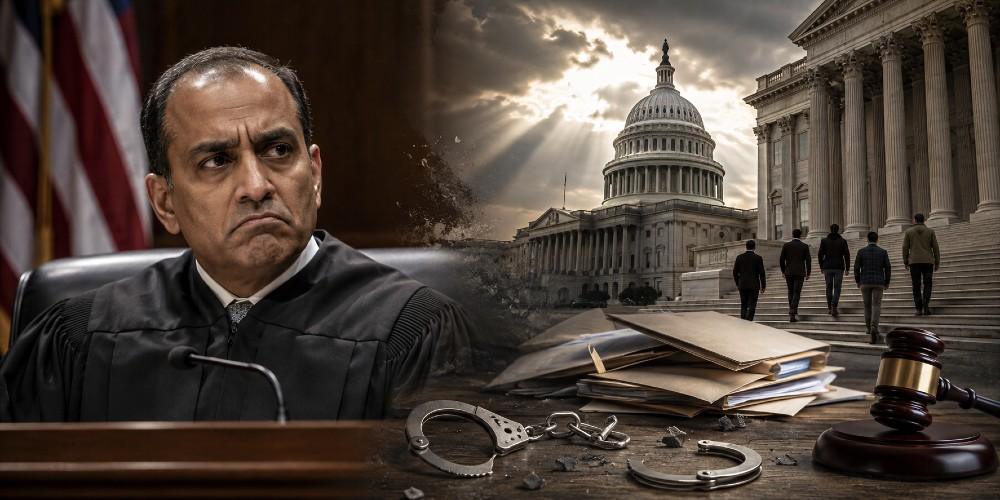
The last major January 6 cases just got wiped off the books, and an Obama-appointed judge is not happy about it. On Tuesday, U.S. District Judge Amit Mehta granted the Justice Department’s request to dismiss the seditious conspiracy charges against Oath Keepers founder Stewart Rhodes and seven other members of the group.
The convictions are gone. The records are clean. The book is closed.
Mehta had no real choice. After the D.C. Circuit vacated the convictions at the DOJ’s request, prosecutors returned to his courtroom and moved to dismiss the superseding indictment with prejudice. Precedent required him to yield. Courts do not get to force the executive branch to keep prosecuting people the President has already freed. Still, Mehta could not resist a lengthy lament.
He called the dismissal an “epilogue” that “diminishes the gravity of that day,” denigrates the work of prosecutors and law enforcement, and excuses acts that supposedly made “a centuries-long pillar of our democracy — the peaceful transfer of presidential power — to buckle.”
He complained the move bestowed “unearned grace” by wiping the defendants’ records clean. He insisted the public interest was not served. Then he signed the order anyway. That is the sound of a narrative dying.
For five years the left treated the Capitol protest as an attempted coup. Rhodes and the others were convicted in two trials of seditious conspiracy and related obstruction charges.
Rhodes drew an 18-year sentence. The media celebrated. Politicians called them terrorists. Yet the same system that hunted these defendants had spent 2020 looking the other way while cities burned and federal buildings were under siege.
President Trump ended that double standard on Day One of his second term. He issued a sweeping clemency order that pardoned nearly all of the roughly 1,600 people charged in connection with January 6 and commuted the sentences of the remaining high-profile defendants, including the Oath Keepers and Proud Boys leaders.
The proclamation itself declared the prior prosecutions “a grave national injustice” and began a process of national reconciliation. The defendants walked free. The convictions, however, remained until the new Justice Department finished the job.
Prosecutors under the Trump administration argued that continuing the cases was not in the interests of justice. They did not claim the evidence was weak or that the trials were unfair. They simply exercised prosecutorial discretion consistent with the President’s directive. Mehta noted that Trump had not issued full pardons to these eight men and women and had not explicitly ordered the dismissals. He still had to grant the motion. Similar dismissals had already cleared the Proud Boys cases weeks earlier under another judge.
Defense counsel for Rhodes put it plainly. The seditious conspiracy charge, he said, was used “as a thought crime.” That description fits. These were not people caught planting bombs or coordinating a military takeover. They were veterans and citizens who believed the 2020 election had been compromised and who showed up to protest the certification. Some entered the building. Some engaged police. The government stretched Civil War-era statutes and conspiracy theories to turn political disagreement into sedition. The same statutes are now being dusted off against ICE protesters, proving the weapon was always political.
Scripture has something to say about this kind of selective justice. Isaiah 5:20 warns, “Woe unto them that call evil good, and good evil; that put darkness for light, and light for darkness.”
For years the establishment insisted the real threat to democracy was a few hundred Trump supporters inside the Capitol, while ignoring months of coordinated leftist violence that left businesses destroyed and people dead. That inversion is collapsing under the weight of its own contradictions.
Mehta is right about one thing. The book on these prosecutions is closed. What remains is the record of how a politicized Justice Department under the previous administration turned a protest into a generational crusade, how judges and prosecutors treated ordinary Americans as enemies of the state, and how a new administration finally restored some measure of balance.
The Oath Keepers walk free without the scarlet letter of a federal felony. That is not the ending Mehta wanted. It is the ending the American people demanded.