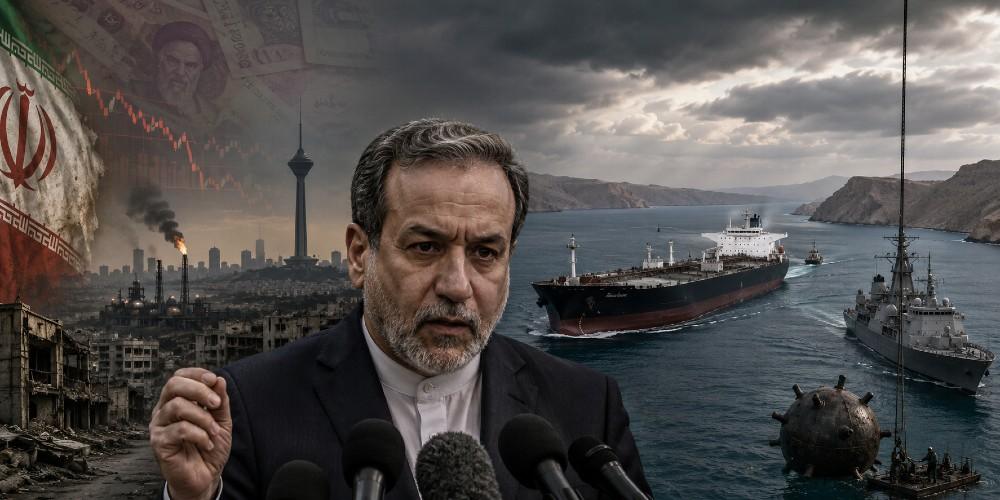
Six months of missiles, mines, and sermons about resistance, and now Tehran has discovered manners. Iranian Foreign Minister Abbas Araghchi spent Friday telling the world that “putting diplomacy back on track isn’t impossible” after “creative discussions” with Qatar.
The regime that spent the last month insisting it would only talk to Oman about seizing the Strait of Hormuz has suddenly remembered that Washington exists.
The catch is the same one Iran always brings to the table. America must stop squeezing. America must speak respectfully. America must “acknowledge our rights.” In other words, the mullahs want the blockade lifted, the sanctions paused, and the cash flowing again before they concede a thing. Pressure, Araghchi insists, does not work.
Putting diplomacy back on track isn’t impossible. It hinges on U.S. understanding of one simple fact: pressure doesn’t work. The U.S. should build trust, speak respectfully, acknowledge our rights, and uphold commitments.
That is a remarkable claim from a government that cannot sell a barrel of oil from its own ports.
The Navy Already Answered the Question
While Araghchi was composing his appeal, U.S. Central Command was announcing something far less poetic. Adm. Bradley Cooper said American forces have cleared Iranian sea mines from the international shipping lanes in the Strait of Hormuz. Navy divers, SEALs, and air power from every service spent months picking those charges out of the water under fire. Cooper called it a major milestone. He was not wrong.
The circumstances were challenging and dangerous, to say the least, but we got the job done. Bottom line: today, international shipping lanes are open, and momentum is building.
The numbers are the part Tehran cannot spin. The United States has escorted nearly 1,500 commercial vessels through the strait carrying some 750 million barrels of crude. Iran has exported zero oil from its shores since the blockade was reimposed in mid-July. No ship enters or leaves an Iranian port without American permission. Humanitarian traffic is the only exception Cooper will grant.
Iran’s earlier plan was not subtle. Talk to Oman. Claim a permanent grip on the waterway. Charge the world a fee for the privilege of moving oil. Oman never signed. The mines are gone. The Navy is still there. The scheme died in the water.
Economic Outcast Is Doing What the Missiles Could Not
The sudden hunger for talks did not arrive by accident. President Trump and Treasury Secretary Scott Bessent launched Operation Economic Outcast this week, the campaign Bessent branded an economic D-Day. Treasury mapped the smuggling networks, sanctioned more than 60 entities, individuals, and vessels, and expanded secondary sanctions across five lifelines the regime uses to stay alive — digital assets, technology, gold, aviation, and shipping.
Bessent’s warning was not diplomatic language. Any country that keeps Iran on life support will share the isolation. “An economic engagement of any kind with this murderous regime will expose those responsible to the full reach of American power,” he said. Trump has been calling heads of state with the same request. Cut Tehran loose or lose the dollar.
Iran’s Foreign Ministry answered with a two-page tantrum. The sanctions are “unlawful.” They violate the U.N. Charter. Every nation is “obliged” to ignore them. Participation amounts to “complicity.” It is the same lecture the regime has given for forty years, now delivered while the rial trades near two million to the dollar and inflation eats through household budgets at rates the government’s own statistics put near 88 percent. Food prices have more than doubled.
President Masoud Pezeshkian has already admitted the country’s problems have “multiplied several times over” while income collapsed.
The LORD bringeth the counsel of the heathen to nought: he maketh the devices of the people of none effect.
Neighbors Stopped Playing Along
Tehran’s plea to the neighborhood might have landed better if Iran had not spent the summer firing missiles at the people it now wants to keep as trading partners. The United Arab Emirates suspended all trade and financial transactions on August 19 after the latest attack. That was not a symbolic slap. The UAE was one of the last convenient doors for sanctions evasion. It just closed.
China is the remaining question, and everyone in this story knows it. Parliamentary speaker Mohammad Bagher Ghalibaf praised Beijing for rejecting American pressure in public and declared that the Iran-China partnership “needs no one’s permission.”
Bessent has already said no one sits above U.S. sanctions, including Chinese banks. Pezeshkian heads to the Shanghai Cooperation Organization summit in Kyrgyzstan next week. Trump is scheduled to sit down with Xi Jinping on September 24. That meeting will tell you more about Iran’s future than any statement Araghchi posts on X.
Trump, for his part, is not playing the old State Department game. He said this week that Washington is not talking to Iran and is not looking for a meeting. The White House line is simple. The economic campaign continues until Tehran comes to the table in a meaningful way. Not with a ransom list. Not with a demand that America pretend pressure failed while Iranian ports sit empty.
This Is Not a Peace Offer
A June memorandum of understanding already tried the soft landing. Sixty days of talks, promises of oil waivers, talk of frozen assets and a reconstruction fund. The clock ran out. Iran kept the strait as a hostage and called it principle. Then the mines, the blockade, and the Treasury campaign arrived, and suddenly Qatar is “creative” and diplomacy is “not impossible.”
Do not confuse a cracked voice with repentance. The Islamic Republic is not asking for peace because it has discovered justice. It is asking because the money stopped. Because the Navy holds the lane. Because the neighbors got tired of being targets. Because a regime that spent decades funding terror with oil receipts is staring at a subsistence economy and calling that proof that sanctions never work.
Pressure worked. That is why they are talking. The only question left is whether Washington remembers it this time.